I was once told that you don't need to put much thought into buying sprockets because all steel sprockets are the same. This sounded like an obvious lie, how can products from many manufacturers be the same when there is scope for differences in metal composition and hardening techniques. There is a range of prices too, why should some cost more than others if they're all the same? These are the results of my own testing performed on a 1994 Honda CB250 Two Fifty, a close relation to the CB250 Nighthawk found in other countries. It is not heavy and it is not powerful so it is possible that sprocket manufacturers don't take small bikes seriously, hence the disappointingly fast wear rates?
Here is how an AFAM looked with a trifling 4515 miles on it:
The teeth are not hooked as normally happens but there is a "step" that has been worn into the teeth that would make it difficult for the roller to leave its snuggly hole, which is likely why it was so noisy. With a new JT sprocket fitted the chain is much quieter. For posterity I took (rubbish) pictures of the other sprockets I've worn out, this is the Sunstar that did 12388 miles:
The teeth have hooked but there is no step, the indents are still smooth. And here is the OEM sprocket that was on it when I bought the bike, it dealt with a chain that had some seriously stiff links for 12K under my ownership and probably quite a few more by previous owners considering the state of the chain:
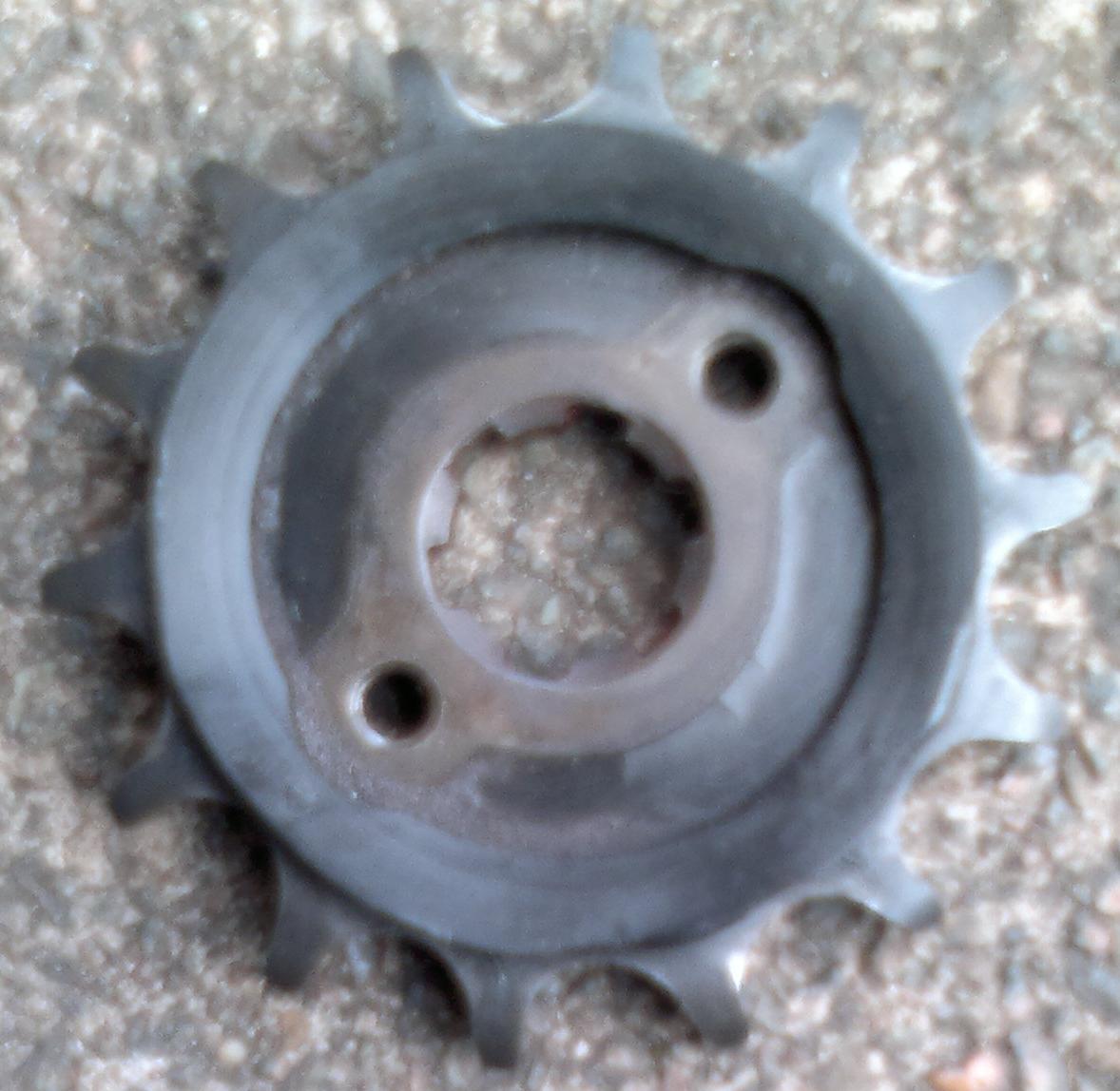
And a clearer picture of each one for comparison:
This week I noticed the chain was clicking when wheeling the bike back down the driveway, so I couldn't ignore the sprockets any longer. After 6844 miles the JT is hooked to buggery:
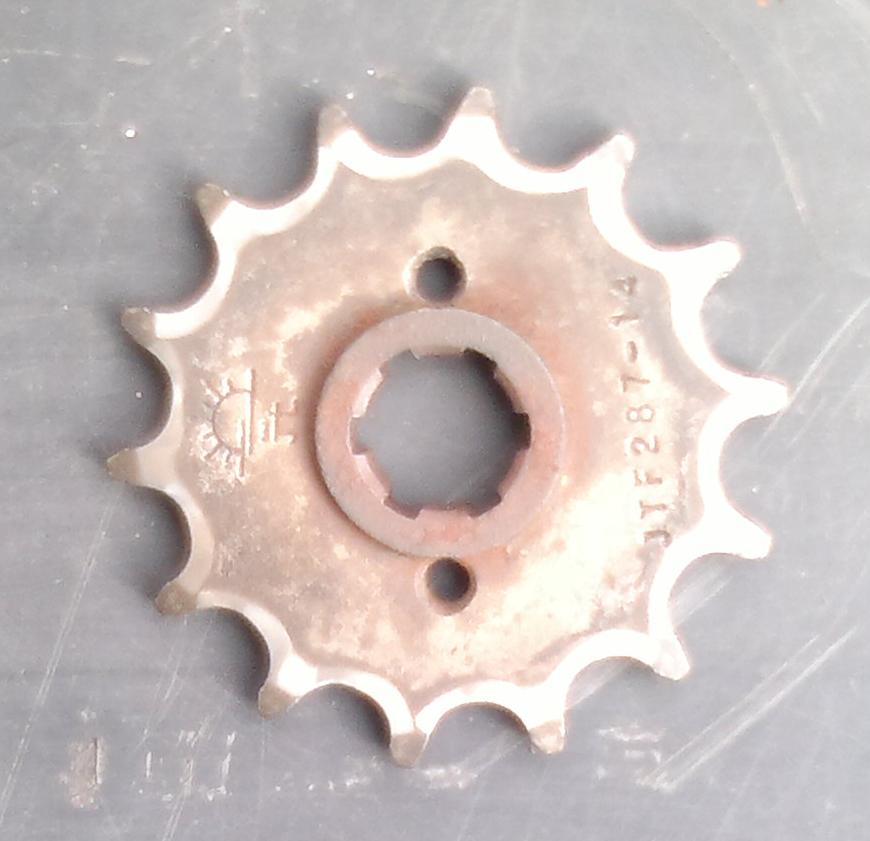
At the same time I replaced the Sunstar rear sprocket with an identical item because they're just that good. Here's the rear after 23747 miles:
Lightly hooked but could go some more. In conclusion, Sunstar sprockets are well worth the extra couple of quid and JT have a reputation for toughness that they don't seem to deserve. Do remember though that this is for small bikes, sprockets for larger bikes seem to last much better so perhaps they undergo different or more treatment.
Next up was an original Honda sprocket, found on ebay for £8. I had high hopes for this as OE sprockets are supposed to be the toughest you can get, and original is usually best. By the time 7K had passed it was starting to get slightly noisy and was noticeably hooked, but the shape of the hook was such that it didn't pluck at the chain as it left the underside - the thing that really did the AFAM in. I decided a quick trip to Scotland was still possible, and came home with 8.5K on it - by this time it was definitely noisy, but still didn't pluck the chain or make graunching noises when the bike was wheeled backwards. I started the search for a new sprocket in earnest, however - it clearly didn't have long left.
With 9252 miles under its teeth a replacement finally arrived from Supersprox, who purport to make custom sprockets but actually don't want to know. By now the OE item was very noisy and for the first time ever was plucking at the chain and making graunching noises when reversed, as the teeth are so hooked the chain finds it difficult to get over them in that direction. It looked like this on the bike:
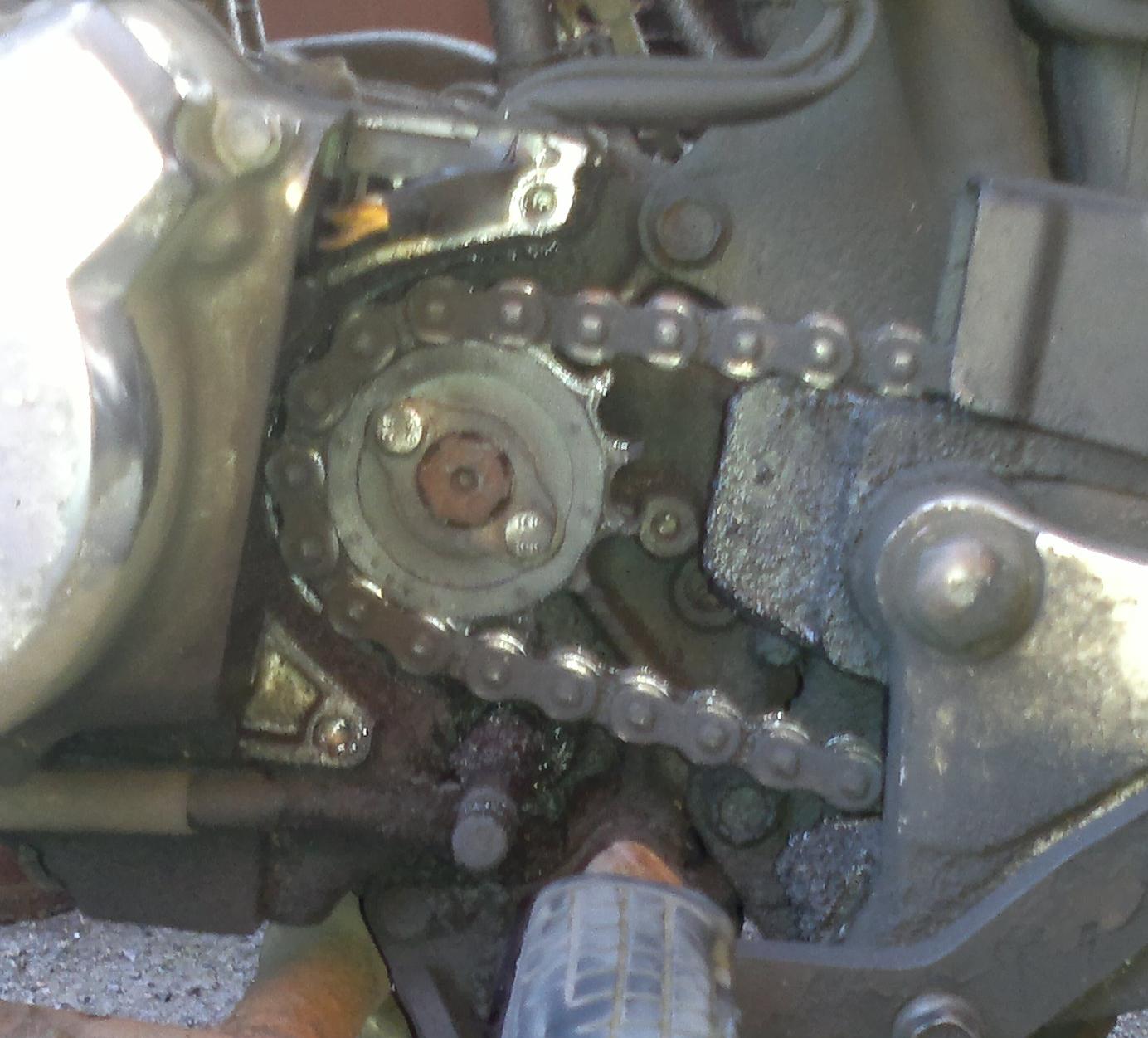
Teeth worn thin and hooked over. This is finished. The wear rate was far from exceptional but the way it wore was very nice, surely the magic of real R&D at work.
By now I am running out of manufacturers to test, but eventually Supersprox were made to send me a sprocket for a CMX250C with 14 teeth, which is the same as the CB250 needs. The initial impression is of a high quality product:
But we shall see about that. They make a big deal about their front sprockets being made with SCM-435 steel which I guess is harder wearing than the SCM-420 that JT uses. But does that make them better?
After running along with no issues for over 7 months I thought I'd have a
check on how the Supersprox was doing. Here it is with 4611 miles on
it:
The teeth are ever so slightly hooked but it looks like it'll go a lot more yet. Testing continues..
..And continue it did. In April 2017 I found the chain was suddenly stretching a lot and very quickly, but that didn't stop me nipping off to Cornwall for a few days. By the time I got back the chain was basically hanging off the sprockets, so a quick inspection seemed necessary. The Supersprox at 7116 miles:
Again slightly hooked and a lot of metal seems to be missing from the teeth (as in they're looking quite skinny now) but still not all that noisy and it isn't picking at the chain as it leaves the underside. I'm somewhat impressed!
The second rear Sunstar is also looking a bit sorry for itself after a mere 16368 miles:
Again slightly hooked but the teeth look skinny. At this point the chain (which has done 40115 miles!) can be pulled quite a way off the rear sprocket, there's at least a millimetre of daylight visible between the chain and sprocket. But how much of this is down to chain wear and how much is down to the sprocket? As you can see the axle is almost at the end of its slots so I won't be able to continue taking the slack out soon, this is in no small part due to the longer shocks I have fitted though - this meant the chain was moved halfway down the slots in one fell swoop. I shall persevere but big money will need to to be spent soon, the bill could be upwards of £50!
While the CB250, err, "had a rest", I have employed a Kawasaki Z250SL for sprocket testing. A JT Z3 chain was paired to a "151214" 14T front sprocket from Techcorps, a manufacturer new to me though they supposedly supply a lot of sprockets to JT. At around 4000 miles it started to get noisy, at 5846 I couldn't take the grinding/clacking any more and had to replace it. The damage:
At £9.95 I expected better life than this but the original sprocket from Kawasaki managed an appalling 4507 so I don't really know what to think - perhaps 28BHP is too much for a 520 chain. Note that this bike doesn't have a chain oiler unlike the venerable CB250 so results may not be directly comparable.
Moving on with the sprocket testing I thought I'd take the opportunity to try yet another sprocket manufacturer - Renthal! At £13.22 it is, frankly, overpriced but needs must and all that. The overall feeling is of a quality product, it reminds me very much of the Supersprox sprocket.. Hmm..?
Nickel chrome molybdenum steel eh?
Sure is purdy but why coat the inside of the teeth??
Testing begins, now with a chain oiler in place so results may be slightly more comparable. I know you're all on the edge of your seats!
Sunday, 24 May 2015
CBX250RS-E Engine Rebuild 16/04/2013
I have replaced the cams and rockers with ones with hardly any scarring from CBX #2 (details of which will come later..) and it now runs almost as quietly as it once did, albeit a bit tappy. I could tighten the clearances a bit more, but I'm still not convinced it's quite right - although I'll happily run it in now. However I have come across something that may help shed some light on the mystery.. While stripping the ruined engine for it's piston (for #2) I had a good look at the connecting rod and saw that the rod from SEP does indeed have an extra hole:
I remember wondering about it at the time but I didn't have anything else to compare it to, since I didn't have other cranks to look at or the old rod. But I wonder if oil can escape more easily from the crank then perhaps this accounts for the seemingly lower oil pressure? Do replacement rods often have new holes in? I don't really know what to make of it.
As an aside the old crank seems fine, no play on the rod up or down, so it must have only been a main bearing. Ah well!
CBX250RS-E Engine Rebuild 04/04/2013
An update! Now that the weather has warmed almost to tolerable levels (at least for the past few days) I have continued to put it all back together. I won't bore you with that again, but today was finally test ride day. I thought that the clockwork knocking noise had gone away, at least a bit, but after getting the motor hot it was back just the same as it had been before I had new valves fitted - so it wasn't the valves making the noise! It seems to run just fine though so screw it for now. Since I now have a spangly smartphone I recorded a clip of the noise (and proof that it runs!), any ideas are hugely welcome.
The noise seems to be mostly from the left exhaust area, which incidentally is furthest away from the oil feed into the rocker cover. The feeds are clear though and plenty of oil is making it to the top, so short of sticking in a tiny camera to see what's going on I cannot verify if it's getting enough oil or not. I also wonder if maybe the exposed bits of metal under the hardened layer on the cams/rockers have corroded a little and are now catching slightly. I am clutching at straws though. Whatever it is it doesn't seem to affect how the bike runs, and if it is just cam/rocker related then it's no big deal to fix later on if I do find out what it is.
CBX250RS-E Engine Rebuild 30/01/2013
My, how time flies. Some time last year I stripped it back down and took the head off and had it sitting around for a bit. Then I bought 4 new valves, two inlets from Econohonda in New Zealand and two exhausts from David Silver. I then took it all to a place called Coventry Boring and Metalling and asked them to fit the new valves and get them to seal - they said they would grind them in as needed. They also refused my offer of a workshop manual, so imagine my surprise when I got the head back and found they had reassembled it with half the valve springs upside down, apparently unaware that they are progressive. I had paid £33.60 for the privilege, too. I then took it (along with another head for another CBX250 I seem to have acquired which needed a valve seat) to Zoom Factory which is a bloke in a room, who cut the seats properly and charged me £60 for the privilege, but at least he knew what he was doing. Long story short, I hopefully have a working head and I am unemployed once more so have the time to do it. Oh hello, you!
One lovely looking head, hopefully sans knocking:
And after a bit of work..
The bolts holding the head down are supposed to be torqued to 50Nm, I got to 40 and went a bit more before wussing out. I think it'll be alright though. The carbs are also currently refusing to go back into their rubbers, even with the help of a rubber mallet - I think this must be down to how cold it is, I have a heatgun if things get desperate. I can't believe how long it's been though, crazy!
2 x inlet valves - £52.63
2 x Exhaust valves - £36
1 x Head gasket (again!) - £14.94
Zoom Factory head work: £60
Running total: 1147.49
Subscribe to:
Posts (Atom)


